
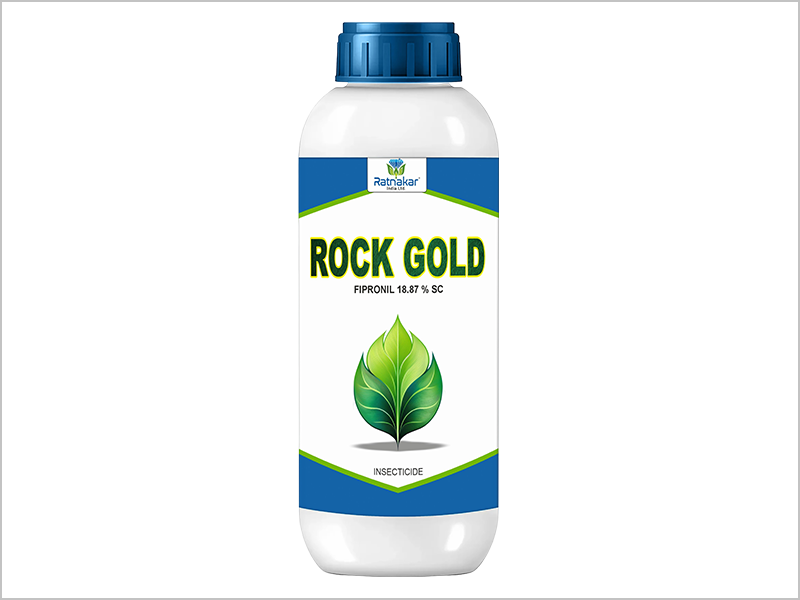
ROCK GOLD
Fipronil 18.87% SC
ROCK GOLD (Fipronil 18.87% SC) is a premium broad-spectrum insecticide and acaricide from Ratnakar India Ltd, Ahmedabad — India's trusted agrochemical manufacturer, supplier, and exporter. Fipronil, derived from Streptomyces avermitilis, provides powerful contact and ingestion action against thrips, aphids, Helicoverpa armigera, stem borers, leaf folders, and Brown Plant Hoppers on cotton, chilli, and rice. ROCK GOLD disrupts insect nervous systems through GABA-channel activation causing paralysis and death. Manufactured and exported by Ratnakar India from Gujarat, ROCK GOLD delivers consistent and reliable crop protection.
| Mode of Action | Contact and ingestion action | |
|---|---|---|
| Recommended Crops | Target Pest | Dose/Acre |
| Cotton | Thrips | 150 ml |
| Chilli | Thrips, Aphids, Helicoverpa armigera | 100 ml |
| Rice | Stem Borer, Leaf Folder, Brown Plant Hopper | 100 ml |
| Packing | 100 ml, 250 ml, 500 ml, 1 ltr. | |
FAQ for ROCK GOLD
What pests does ROCK GOLD control?
ROCK GOLD controls thrips in cotton, thrips, aphids, and Helicoverpa armigera in chilli, and stem borers, leaf folders, and Brown Plant Hoppers in rice through contact and ingestion action.
How does Abamectin in ROCK GOLD work?
Abamectin enhances GABA-gated chloride ion channel activity in insect and mite nervous systems causing irreversible paralysis and death through contact and ingestion modes of action.
Is ROCK GOLD effective against Helicoverpa in chilli?
Yes, ROCK GOLD provides effective control of Helicoverpa armigera (American bollworm/fruit borer) in chilli at 100 ml per acre, protecting fruits during critical development stages.
What is the recommended dose of ROCK GOLD in cotton?
For thrips control in cotton, ROCK GOLD is recommended at 150 ml per acre. Apply when thrips populations are building up during early vegetative and squaring stages for best results.
Can ROCK GOLD be used for BPH control in rice?
Yes, ROCK GOLD controls Brown Plant Hopper alongside stem borers and leaf folders in rice at 100 ml per acre, providing broad-spectrum pest management in paddy cultivation.